
Decreased funding possible for area schools
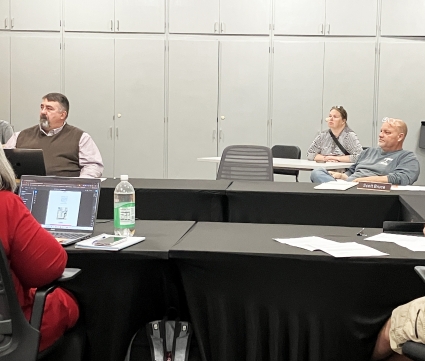
Area schools such as Red Oak will be facing some funding questions if new bills at the statehouse pass.
According to lawmakers, Senate Study Bill 1227 and House Study Bill 328, will overhaul the state’s property tax system, replacing a rollback on residential and commercial properties with a “revenue-restricted” system, allowing taxation at the full assessed value of a property, but limiting the amount of new tax revenues local governments can collect.
Matt Gillaspie, senior vice president of public finance at Piper Jaffray & Co. in Des Moines said the funding formulas could create a crunch, and outlined the effect it could have on the Red Oak district.
“We have estimated what your taxable property value would be basically next year. So it’s the current property value that we already know, but then we just assumed that it would be 2%. So that would be about $473.9 million. That is the capital levy, your debt service levy, schools that have a parole levy, all of those things would be based off of that number, $473.9 million. Now, if the legislature’s current proposal were to actually be passed, what they would be doing would be eliminating the rollback on residential and commercial property, but not changing anything about ag property,” explained Gillaspie.
Gillaspie then broke down how that rollback will affect how taxes are paid among the three tiers.
“For argument’s sake, let’s just assume it’s 50%, to make it simple. So what they did is they said they’re going to eliminate the rollback. That means that somebody who currently has a $400,000 house, but they only are paying taxes on $200,000, they’re all of a sudden going to be paying taxes on $400,000. So the legislature said because we’re going to do that, we’re going to basically double the taxable value of that home, we’ll cut the levies in half. Which, if that was the only part of this, that would work, because if you double the value of property, it takes half the levy rate applied to double the property to generate the same amount of money,” Gillaspie advised.
Gillaspie said the issue with the halved levy comes into play when it comes to taxes on commercial and agricultural property.
“For commercial property, they’re already paying taxes on 90%. The first $150,000 of commercial property in any business or building, it gets this almost 50% rollback that residential property gets. Anything above $150,000, it’s paying taxes at 90%. So if they eliminate the rollback on commercial property, yes, the taxable value is going to go up, but it’s really only going to go up 10%, not 50%. It’s not going to double the residential property,” Gillaspie stated. “Agricultural land today pays taxes not anywhere near the market value, but on the assessed value. They pay taxes on roughly 75% of the assessed value. Under the new law, they would still pay taxes on roughly 75%. So the levy rate would be cut in half, but that half of the levy rate would be applied to the same amount of value, only 10% more in commercial value, and it would be applied to roughly double the residential value, so it doesn’t generate the same amount of money or the same capacity to borrow against.”
Further, if a house is assessed for $100,000, under the current system, the owner would be paying taxes on roughly $50,000, minus $4,850 in a Homestead credit, so somewhere around $45,000. Under the new system, the owner will still have a $100,000 house, but it doesn’t have any rollback, but they will get a $50,000 homestead credit. They would just be paying taxes on $50,000, which is just a little bit more than the $45,000 that same house is taxed on under the current plan. The problem arises when the house is valued for more.
“If you have a $400,000 home under the current plan, that would take your taxable value down to roughly $200,000 and then minus the $4,850, so around $190,000. Under the new plan, that $400,000 home would just get a $50,000 reduction. That’s it, and you’d pay taxes on $350,000. So you’d be paying taxes on $350,000, which is more than double the taxable value today, and you’d be paying about half the levy. So for residential property owners, you would actually be paying more than you are paying today. because the commercial properties will pay less and the ag will pay a lot less, like 50% less,” commented Gillaspie. “Overall, across the entire state, it’s true that property tax dollars would go down, but from a homeowner’s point of view, they wouldn’t go down. It would be different pockets of types of property owners.”
The rollback on residential property will likely jump around 47% in fiscal 2026, which begins July 1. The legislation would also move around $426 million in public school funding from property taxes to the state after reducing the base tax levy rate for school districts from $5.40 per thousand dollars valuation to $2.97. Lorenz said he had other misgivings about the proposed plan.
“I hear the legislature saying we’re going to pick up more of the tab. But how many times have I heard, ‘Well, we’re going to set Supplemental State Aid really quickly so schools can get their budgets done. And by the way, we know that there’s a statutory obligation that we need to set that within 30 days.’ They don’t even acknowledge that anymore. I have no reason to believe that even though they say now that they will fund a greater percentage of the foundation formula, that it’s going happen,” said Lorenz.
Gillaspie said the bills still need to go through the Legislative Services Agency, and said some legislators have seen the math thanks to constituents urging them to see the math. He urged the Red Oak School Board to make their voices heard.
“You are elected officials, and you are speaking for your citizens. When someone like me complains, what do you think they see? They see somebody that makes money when schools borrow money. And so therefore, why would we want things to change? Why would we want things to be where you can’t borrow as much money? Then we make less money. There’s still time for you to talk to and contact your legislators. Because they will listen to you, I’m not saying always, but they will definitely listen to you more than they will listen to me, or probably Ron Lorenz, because Mr. Lorenz is not an elected official. You have a lot of power as a school board member,” advised Gillaspie.
Lorenz agreed, saying he has conversations with representatives and has very good relationships with them and they listen and are very attentive, but if they don’t hear from the board and don’t realize it’s a big deal, they merely hear Lorenz advocating for school funding.
No other discussion was held on the state funding changes.