
Residents voice concern over eminent domain issue
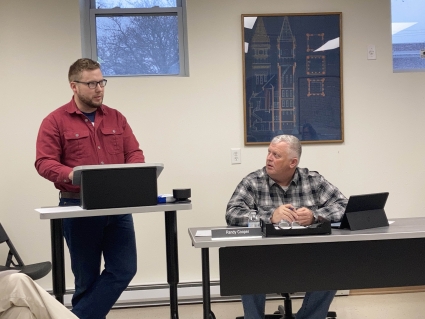
County residents in attendance at the Montgomery County Board of Supervisors meeting March 22 were all in agreement. They want the supervisors to join other counties in pushing back against the use of eminent domain if used to further the Summit Carbon Solutions pipeline project.
The subject of eminent domain was on the agenda at the regular meeting on Tuesday, and the supervisors opened the discussion for public comment. Susie McDonald was the first to speak. McDonald, who lives south of Emerson, said her husband is a third generation farmer, and had concerns.
“The whole idea of eminent domain, which gives a private company to have the right to come in and say this is what we want to do, and usurp the right of the landowner themselves, and take away their ability to have a decision in that process is troubling,” McDonald said.
Next to speak was Bill Honeyman, who also lives near Emerson. Honeyman said he wanted to be on the record voicing his objection to the pipeline and against the use of eminent domain.
“I fail to understand how it serves the public interest when it results in thousands of acres of Iowa farmland being condemned. There is public land available along roadways and other publicly-owned property that could be utilized rather than seizing and destroying private property. Furthermore, if eminent domain is granted, I strongly oppose the permanent easement of property, and feel the project is a misuse of resources,” commented Bill.
Also voicing concerns was Tom Honeyman of rural Emerson. Honeyman said he was strongly opposed to any private company seeking eminent domain and felt the project would not solve any carbon problems.
“It will not raise the price of corn, nor will it save the ethanol industry. The maneuver is basically theft. If I were to rent land, or oblige an easement, I would expect to be paid annual rent or damages. I don’t know of any farmers that would expect to farm their neighbor’s land without paying rent for the use of it, and the state utility board should not have the right to decide the future and well-being of the property,” Tom stated.
Honeyman also felt the project was unprofessional, disorganized, false information was being presented, and a lack of information was being presented, and from the start, he has not been able to get in contact with anyone who knows exactly where the pipeline will be on his property.
Maggie McQuown, who lives on a Century Farm just outside of Red Oak, said that while she was not personally affected by the project, she was speaking up for other farmers who would be directly affected, and the type of project being considered was dangerous.
“The very nature of the docket listing says this is a hazardous liquid pipeline is disturbing. The technology of transporting carbon over long distances is unproven, and the unintended consequences of this experiment could be greater than the benefit. Also, the pipeline will run through the Walnut Creek, Indian Creek, and Old Nisnabotna watersheds, and these are top-priority watersheds for erosion and flood control. The pipeline will disturb these soils, and once soil is disturbed, it is very hard to control erosion,” advised McQuown.
Jan Norris, a rural Emerson resident, said the pipeline would go behind her house, between her farms, and urged the supervisors to object to the use of eminent domain for private gain.
“Eminent domain does have its place, and can serve a valuable purpose. However, Investopedia can be quoted as saying there have been instances where a private party has used eminent domain seizures under the guise of public improvement. This appears to be one of those cases. Summit Carbon Solutions wants our land so they can make billions from our tax dollars. So far, 24 counties, six cities, one school, and one faith community have all formally objected to the use of eminent domain on these pipeline projects,” explained Norris.
Barb Nelson, who lives in Stanton, cited that the pipeline project had real potential for eminent domain abuse. She cited the state requirements that would be placed upon the supervisors if the pipeline project were to proceed.
“The county selects a certified inspector for pipeline construction, paid for by the pipeline, but that’s all the pipeline pays for. If eminent domain is used, the county with a district court judge, appoints a compensation commission to determine compensation for land,” Nelson advised. “The county must set up a digital folder with subfolders for each tract of land affected and store all reports re pipeline business, and must oversee inspections with updates and filing reports being recorded. If the construction inspector files a notification of violation that is not corrected by the pipeline, the county gets involved with next steps. The county engineer is involved with inspecting pipeline road crossings. The supervisors certify the completion of the pipeline when vegetation reaches 70% growth across the project, and the compensation board hears landowner claims for damage and decide awards. This would put a lot of work on the county, and we would lose local control.”
Last to speak was Steve Dolch, of rural Villisca. Dolch said he was concerned not only with the eminent domain, but with the pipeline going through the property, as he has a waterway that needs to be honed out.
“They talk about the pipeline being four feet deep. I plan on taking two feet of that dirt out of that waterway. I am also against the permanent easement aspect of the project either. I have been associated with eminent domain before, and nothing good ever comes out of it,” Dolch said.
No action on eminent domain was taken by the supervisors, but all of them voiced the same concerns as the public, and were against the use of eminent domain to take farmland for the use of the project. Supervisors Chair Mark Peterson felt eminent domain was an unfair ace in the hole.
“What two parties do on their own, on a level playing field is one thing. Eminent domain takes away the level playing field. I have received a number of phone calls, and I have yet to get one in favor of the pipeline,” stated Peterson.
The supervisors advised the comments received from the public would be used in their decision on opposing eminent domain usage for the pipeline project.