
Phase two of cemetery kiosk project now fully operational
The cemetery kiosk project at the Evergreen Cemetery has expanded into a new phase.
Around June of 2023, fundraising efforts were underway for the first phase of the project, replacement of the old kiosk at the cemetery. Evergreen Cemetery superintendent Brad Baker said they were compelled into action because the former information system was no longer going to be available.
“We were at a situation where the host was no longer employed by the city, and our contract had run out. The system had been in play for a lot of years, and was honestly ahead of its time for a number of the years that it was in place. I kind of saw some of the writing on the wall and reached out to try and get something organized,” Baker explained.
Concerned over the loss of data of hundreds of people buried at the cemetery, Baker ended up contacting Beau Boeye, owner of Boeye Tech & Design LLC, to try and figure out steps to maintain the information.
“I was concerned that we were going to lose all the existing data in the database, and I was very concerned that we were going to have to start over, and wasn’t sure what we could do. Beau Boeye started working from the inside out on that. At the same time, we started researching platforms that we could invest in the programming and and then bring it here. It was high cost, somewhere around $60,000 for a platform, which would have been tough to afford. Then one day he told me that he could design something himself that would meet the same needs as a platform we bought into, and he delivered a platform that, in my opinion, is way better than anything we would have bought,” Baker advised.
Boeye said phase one not only included fundraising, but also included a lot of time spent retrieving data before it was lost for good.
“We had to retrieve said data. We didn’t have that data in our possession. There wasn’t a spreadsheet or anything like that that we just had access to. So that required scraping the data from the previous system, which was an interesting process. Thankfully, we were able to collect all that data before the whole program went away and we couldn’t access anything anymore. After we collected it, we had to find a place to take that data,” Boeye explained. “After reviewing some different options and watching some different YouTube videos of how some other municipalities have set it up, I found it wouldn’t be too difficult to store it. So then we started to explore.”
Baker gave a lot of credit to Elaine Hollen, as she stepped in around the time that Baker and Boeye were working on the project to help find funding.
“Elaine came in during one Memorial Day and said she had friends in from out of town who wanted to look up some records. While we found them, she asked why the rest of the system wasn’t available. I explained what was going on, and she said we needed to get something. She wanted to start a fundraising campaign, and she did. By Junction Days in June, she had a full campaign started with the city’s blessing. While she was doing that, we wrote some grants and did some stuff, and we raised money for all of phase one and had some excess for jumpstarting phase two,” stated Baker.
While data mining was one of the hardest tasks, Boeye said there was another element to the first phase that took a lot of work.
“One big element to the project was the digitization of the parcel maps and the plot maps that we had. Thankfully we had the actual physical copies of that. We owe a big debt to the Montgomery County Secondary Roads Office for letting us take the 100-year-old maps which we then passed through a large format scanner that we used to digitize it. After that we had to take the digital scan and overlay that on GIS mapping,” commented Boeye. “Probably the most tedious process was creating all of the polygons to match. Because then once we had all the polygons created, we had to associate them to the data that we had. That was the most labor-intensive process to it all. Barry Byers from the engineer’s office then utilized the county drone to do some aerial imagery so we had quality imagery to have all the polygons on. On the system, you can toggle between the old maps or the drone imagery.”
The official launch and ribbon cutting for the updated kiosk took place in December, 2023. Even then, work had been going on before transitioning from phase one to phase two, though the results have been great.
“It’s neat to really think about how the whole project evolved, how we decided to plot the burial sites to the different iterations of the app. I’m glad that we landed at where we did, because the other methods were not as ideal. Initially, we were going to look towards building a system where we had to go out and GPS stick to get locations so that we had 66 acres stored in something that was searchable and could get people from here to there. So we didn’t have to do those steps due to what we were able to put together. It changed the dynamics immensely. We’re still taking suggestions on ways to continue to improve things, but it’s phenomenal where it’s at,” Boeye stated.
As for the new phase two, Boeye said the idea for it came about still in 2023, while they were trying to choose the best system.
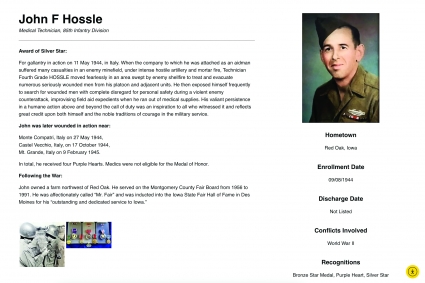
“The Hossle family sent in some information about John Hossle, a veteran from their family. They knew we were working on things and asked if we could ever get to a point where we could have a military history page, or expand the graveside listings, as at the time, it was pretty much name, birth date, death date, birth place, death, place of death, funeral home, and a little blurb on their government or military service, but the data was small. It just always stuck as something I wanted to do,” Boeye said. “By the next Memorial Day in 2024, we were officially running and trying to get people acclimated. I did stay on because we had the fundraising, and I knew we could build into the system more so we kind of looked at how complicated it’d be to do this and include a database if the person was a first responder.”
The phase really took off, Boeye said, when someone told him he could find a lot of information on the veterans at the Restored Burlington Northern Railroad Depot and World War II museum.
“That’s really what helped give me additional motivation to seal the deal on getting that Phase 2 done. I believe the museum utilized the same person that built the original cemetery kiosk. They built a kiosk at the museum that had military information in it. I was thankfully able to have access to the database and was able to see that there were around 700 or so entries of veterans in that system. It had a plethora of information. Each entry had a good amount of data to it,” advised Boeye. “It even had 400 or so individuals that had photos associated with them too. When I finally was able to sit down and look at that database and figure out how to extract the data from it, it occurred to me that if we can gain access to this data and use it, that it was going to make a better system than getting individual information from each of the families of the veterans who have been buried here. Being able to launch it with 700 individuals, I think, was a benefit to everyone who may use it.”
To make things a bit uniform in the information, Boeye said he utilized some tools in the organization process.
“This is one of those instances where the use of AI was really helpful for parsing out that data. With all those hundreds of word files, all the information was a bit different. It didn’t have a structure to it. Everything was just paragraphs and whatnot. Utilizing some various AI techniques, I was able to parse that data into a structured format that I could then build a new website database around. Once I figured out that workflow, it only took a few hours to export the data that I needed to the new website that I had created,” Boeye commented.
The website cemetery.redoakiowa.com is the site being used for the information. While not available as a downloadable app, it can be found on a Google search as well. Boeye said originally the site would take you right to the splash page for the cemetery kiosk for the burial records. Now it has expanded to include that information, as well as go into the database for the veteran memorials or get general information for the cemetery itself.
“Now that we have this full fledged website, we can start adding to it. In addition to those original records, we’ve also got some submissions. There is a pull down tab for visitors to the website that the can use to input their own information about their family members to submit,” stated Boeye.
Baker said that the new phase has allowed him to expand his own knowledge about the history of the veterans at Evergreen.
“I’ve got one family who has opened up all their shared family files to me, and the gentleman in question was lost at sea. It was quite a story. They’ve got his government marker placed here and they’ve opened this door to us to look at and garner what we wish. Kenny Hamman has provided pictures of firemen that are buried out here. We’ve got some sheriffs that are buried out here and police officers, so we’re going to expand it to military and first responders. I’d say that’s phase 2.5 of this project so far,” explained Baker.
The addition of the veteran information was added to the website during Memorial Day of this year. Baker and Boeye said there was a push to have it live and available by that historic annual observance. Also, Baker said they’d like to add some information from Questers and others in the area as well.
“The information that they’ve collected, and the research that they’ve done, it would be great to preserve that for them and display it. They’ve been coordinating the annual cemetery walk which is a great event when it occurs, and it would also be great to have those stories and have them on display on our website. I know that when they did the first one, they tried having recordings of the people. I hope that they did that for the second one as well. It would be great to be able to have uploads of those reenactments,” Baker commented. “Dave McFarland has done a bunch with the History Center that we will make sure that we incorporate. Jim Hoskinson is constantly working on projects. I know he’s looking at those buried out here that were killed in action. There’s just a lot of things, and I believe the people that do the research and take the time to put things together would want to make sure we had room to support them on these platforms. I certainly could see that being a phase three.”
Boeye said another feature they would like to incorporate is the ability to create story maps.
“We can create a little web app experience that would be kind of like a slide show that they can go through, but with the mapping data that we have, you’d click next, and it would cycle you over to the burial location, and then on the screen, list information about the person, and then even include potential research that the Questers have done, and even include a video. They could then go beyond that and then move on to the next individual on the map,” said Boeye. “I think there’s some story maps that we can possibly start creating through a partnership with the Questers. The Montgomery County Historical Society, the Historic Preservation Committee, they’re working on some things out here too with the Merritt family. We have recognition as being on the National Parks Registry for William Wallace Merritt, who was a captain in the Underground Railroad. We just want to be able to make sure that the information is funneled, that we can get it shared for the people who are also working ancillary projects out here as well.”
While there’s not an active fundraising effort going on right now, Baker said they’re always open to additional donations for future phases by making a donation at Red Oak City Hall and noting the donation as earmarked for the cemetery kiosk. Baker also said that the type of system at Evergreen is quite unique.
“I can tell you that I’ve been to a lot of cemeteries. I was just out in Omaha, took my mom out to her brother who passed away during the COVID-19 pandemic. Of course, they couldn’t have a funeral. I was given two pieces of paper. One showed me how to get back to the section, and the other showed me where he was at in the section. It’s a very large cemetery in Omaha, and they don’t have any electronic system. Most of the southwest Iowa cemeteries have a board, if they have anything. And you go and you find the number of the grave location, there’s a map, so you get a general idea that way, but there’s nothing electronic, to my knowledge. I haven’t been to every cemetery in southwest Iowa, but I don’t know of anything close,” Baker stated.
Baker credited Boeye for being instrumental in not only designing the kiosk and website, but saving important information from being lost for good.
“I can tell you that the work he put into this was huge. He was really the spine of this project. Elaine and I helped, but he was the one who really did all of it. Without his effort, it’s lost. It’s history lost. It’s information that no matter how many people would have sat there putting data back in, it never would have been the same,” Baker commented.
Boeye added he’s enjoyed being able to work with Baker and maintain this information for the future.
“Working with Brad is great because we just throw stuff at each other and bounce off ideas and everything. It brings me a lot of joy that I was able to work on this project and save this information to the community and create something that’ll last for at least another generation,” Boeye said.